
Why a scoping workshop at the start of a Shopify redesign project?
Feedback from Urban Design Care

Project Scoping for Website Redesign
At DBM, we like to say that a website is never designed behind a screen. A successful website is first and foremost a story of meetings, mutual understanding, and shared vision. This is exactly what scoping workshops allow: privileged moments where we take the time to listen, observe, question… and above all to understand.
This week, our team — technical experts, UX/UI designer, and project manager — traveled to Portugal to meet with a client we have been supporting for several years in their online sales project: Urban Design Care, a brand specializing in professional manicure and nail art products (urbandesigncare.pt). Objective: to prepare together the redesign of their custom Shopify e-commerce site, identify immediate improvements, and lay the foundations for a solid, aligned, and ambitious project.
And as often happens, these days were much more than just a simple workshop.
1. Scoping Your Project: The Foundation of a Successful Redesign
A redesign project can quickly become complex: multiple expectations, technical constraints, business issues, UX needs, internal organization… Scoping workshops serve precisely to bring everyone back to the table to clarify, prioritize, and align.
With Urban Design Care, we worked on several essential areas:
- Understanding the business and internal processes: logistics, HR, marketing, customer service, production.
- Identifying friction points that hinder user experience or site performance.
- Defining a short-term improvement plan with quick wins that can be activated immediately.
- Precisely scoping the website redesign project: objectives, features, architecture, content, technical integrations.
- Preparing a clear specifications document, which will serve as the backbone of the project.
This project scoping example confirms once again that this type of workshop is a valuable investment: it avoids misunderstandings, secures the timeline, and guarantees that the redesign rests on solid foundations.
2. A Multi-Phase Immersion: Understanding Before Designing
Nothing replaces field immersion. By spending two full days at Urban Design Care, we were able to experience their daily life, meet the teams and ask them the right questions, observe workflows, understand constraints… and feel the energy that drives the brand.
Throughout the exchanges, we:
- identified issues related to the company’s strategy, its growth in Portugal and internationally,
- clarified their business objectives, particularly increasing foot traffic in their Lisbon store,
- discussed HR, logistics, marketing, and sales issues with the teams,
- observed order preparation and inventory management,
- analyzed the use of site tools and features (SAGE, Shopify, WhatsApp, helpdesk).
This immersion allowed us to better understand their challenges: delivery times, internal organization, mobile experience, content consistency, workflow automation, customer support management…
It is this fine understanding that then allows us to provide advice and propose an adapted redesign.
3. Quick Wins and Web Project Scoping Document: Immediate Results and Clear Vision
A scoping workshop is a key step at the beginning of a project. It’s not just an analysis moment. It’s also a time for action. With Urban Design Care, several optimizations were identified and prioritized from the first day:
- improving mobile display on certain key blocks;
- UX optimization of the purchasing journey;
- recommendations on using WhatsApp as a communication channel;
- initial ideas for structuring an omnichannel helpdesk;
- advice on inventory management and tool synchronization.
In parallel, we laid the groundwork for the UX scoping of the future website:
- information hierarchy;
- content organization;
- priority features;
- technical integrations;
- multilingual requirements;
- automation;
- user journeys adapted to different segments (professionals, distributors, individuals).
This work is essential for writing complete specifications, a reference document that secures the continuation of the project.
4. A Collaborative, Rich, and Decisive Workshop for What Follows
What stood out during these days, beyond the technical aspects, was the quality of exchanges between participants.
The Urban Design Care team was open, involved, and transparent.
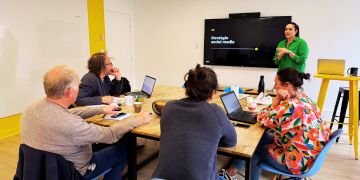
This collaborative workshop allowed us to move quickly, solve certain issues in real-time, and co-construct a clear scoping document for the site redesign.
This type of workshop allows:
- aligning stakeholder visions;
- removing ambiguities;
- strengthening collaboration;
- creating positive momentum around the project;
- ensuring the success of the redesign project.
For Urban Design Care, these days mark the beginning of an ambitious, structured project perfectly aligned with their growth challenges.
An example of successful digital project framing… and in English please!
This type of workshop is not a formality: it’s a key moment that determines the success of a digital project. It allows us to strengthen the client relationship, understand the company as a whole, identify priorities, define a scoping document, a clear action plan, and build solid specifications.
The experience with Urban Design Care is a perfect illustration: field immersion, rich exchanges between participants, concrete solutions, advice, and a shared vision for the future.
At DBM, we are convinced that a successful website always starts with a deep understanding of the company it must serve. And this is exactly what scoping workshops allow.
To know more
What is a project scoping workshop?
A project scoping workshop is a collaborative session that brings together stakeholders to clearly define the objectives, scope, and main outlines of the project. This scoping approach allows aligning everyone’s needs, identifying necessary human resources, and establishing a macro-planning with key dates. The workshop aims to create a shared roadmap and lay solid foundations before project implementation.
Why hold a scoping workshop before a redesign?
The scoping workshop avoids budget overruns and frequent delays in IT redesign projects. This collective reflection allows identifying major risks, clarifying the project scope, and anticipating resistance to change. Without this preliminary phase, many redesigns fail due to lack of common vision among stakeholders.
How to define the scope of a project?
To successfully execute project scoping, start by organizing interviews with team members to understand the project context and define measurable objectives. Then formalize these elements in a scoping document that specifies the budget forecast, required human resources, and macro-planning. Finish with a kick-off meeting to validate project governance and create optimal conditions for project progress.
What are the deliverables of a framing workshop?
A scoping workshop produces several essential summary documents: a detailed roadmap with project milestones, a quantified budget estimate, the definition of roles and responsibilities of each participant, as well as an operational schedule. These deliverables also include the identification of major risks, result validation criteria, and a communication plan to ensure the project progresses smoothly.
How long does a framing workshop last?
A scoping workshop generally lasts between half a day and two days depending on the complexity of the web project. Simple projects require 3 to 4 hours of collaborative work, while complex projects with multiple features require up to 2 full days. This duration allows teams to effectively define the common vision and establish solid project foundations.